

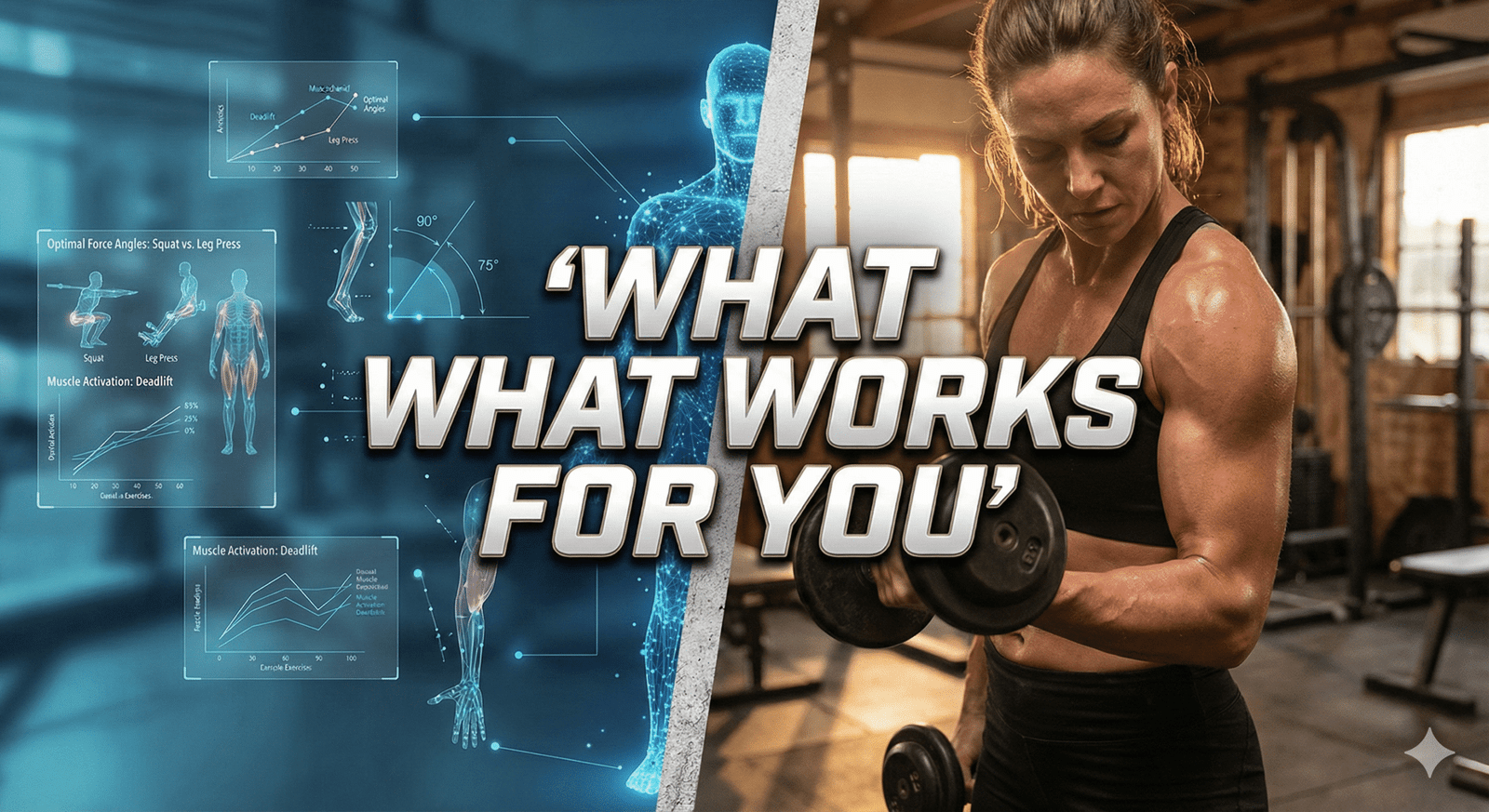
The fitness space loves absolutes. “This is THE BEST exercise for chest.” “If you’re not doing this movement, you’re wasting your time.” “Science proves this exercise is superior.”
Here’s my take: they’re probably right about the science. But they’re probably wrong about what it means for you.
The Missing Variable in Every Exercise Debate
Let’s say Exercise A is objectively better than Exercise B for targeting a specific muscle. Better stretch. Better contraction. Better muscle fiber recruitment under controlled conditions.
Sounds simple, right? Just do Exercise A.
Except there’s a problem: what if you don’t know how to work the muscle itself?
You can perform a technically “superior” exercise with perfect form and still get inferior results if you’re not actually engaging the target muscle. You’re just moving weight around, letting your stronger muscle groups compensate, never building that crucial connection.
In that scenario, changing the exercise doesn’t help. You’re bringing the same problem to a different movement. You might actually get worse results because now you’re doing an unfamiliar exercise while still not knowing how to activate the muscle.
The Rules Keep Changing (Because Context Matters)
Here’s something that should make you skeptical of absolutes in fitness: the “rules” keep evolving.
Take training frequency. Back in the day, conventional wisdom said you couldn’t bench press every day. Rest was sacred. High frequency was dangerous.
Today? People are doing LEGS every day. Programs built entirely around daily lower body work. Athletes making gains that would’ve seemed impossible under the old paradigm.
The truth: both approaches can work, depending on the person, their recovery, their technique, and their programming.
There are no universal rules—only principles that need to be applied to individual contexts.
Focus on What Actually Works for You
This is where most people go wrong. They’re so busy chasing the “optimal” approach that they abandon what’s actually producing results.
Here’s what matters: What works for YOU?
Not what works for the guy on YouTube with different genetics, different training age, and different goals. Not what the study showed worked for the average subject. What produces results in your specific body with your specific circumstances.
If you’re comfortable with an exercise, you can feel the muscle working, and you’re making progress—congratulations, you’ve found something valuable. Don’t throw it away because someone claims there’s a 3% better option.
Yes, learn from others who share your goals and body type. Yes, experiment intelligently. But always filter everything through what actually produces results for you.
It’s ALL about YOU. Your body. Your response. Your progress.
The Real Skill to Develop
Here’s what will serve you better than finding the “perfect” exercise: learning to work your muscles so well that you can make almost any exercise effective.
Build that mind-muscle connection. Master muscle activation. Get so good at engaging your target muscles that the specific exercise becomes almost secondary.
That’s the skill that pays dividends for life. That’s what transforms you from someone who follows programs to someone who understands training.
That’s Thursday’s Thoughts. Now go apply it.
Leave a Reply